
Cox Business — Resolve My Issues Journey
Transforming Reactive Support Into Predictable, Human‑Centered Resolution (2018-2021)
Overview
Cox Business serves some of the most critical institutions in America — hospitals, schools, banks, and small businesses whose operations depend on reliable connectivity and rapid access to support. Yet for many years, when issues occurred, customers found themselves stuck in a maze of inconsistent processes, siloed teams, and delayed resolution.
I was asked to take ownership of the entire Resolve Journey — the highest‑stakes, highest‑frequency, and most emotionally charged customer journey within the Cox Business ecosystem — and redesign it end‑to‑end.
The mandate was clear:
“Own this journey end‑to‑end — from the first ‘Help!’ to the final ‘Fixed.’”
The Customer Reality: Pain You Can Feel
Imagine this scenario…
You’re the owner of a small accounting firm. It’s peak tax season. Your internet goes down.
You call Cox Business, and then:
- You’re transferred between three different agents
- You wait hours for updates
- You finally learn it requires a technician — tomorrow
In that moment, the customer isn’t thinking about network architecture or operational constraints.
They’re thinking:
“My business is losing money and I can’t reach help.”
And this wasn’t a one‑off — it was a pattern.
Diagnosing the Root Causes
Through customer interviews, journey mapping, operational analysis, and field observations, we uncovered three systemic issues driving the pain.
Challenge 1: Fragmented Customer Journeys
Silos = Suffering
Sales, support, billing, and field services each operated their own processes, systems, and definitions of “done.”
A customer told us:
“I feel like I’m reintroducing myself every time I call.”
Operational impacts:
- Customers repeated their story
- Agents had to manually coordinate across teams
- Handle times and escalations skyrocketed
- Trust eroded with every hand‑off
Silos didn’t just break journeys — they broke relationships.
Challenge 2: Complexity of the Cox Business Portfolio
When “More” Means “Worse”
Cox Business offered a rich, enterprise‑grade portfolio — internet, voice, security, video, cloud solutions — but the operational experience wasn’t designed for this complexity.
We heard:
“I keep a cheat sheet under my keyboard to navigate our own systems.” — Support Agent
Impacts:
- Customers struggled to understand what they bought
- Agents used workarounds to deliver support
- Sales, provisioning, and support all interpreted products differently
Complexity had become a tax on customers, agents, and the business.
Challenge 3: Reactive Support Model
“Call us when it breaks” doesn’t work for hospitals.
The legacy model:
- Customer reports the issue
- Agent diagnoses manually
- Technician dispatched (eventually)
A hospital director summarized the stakes:
“When we call you, it’s not a complaint. It’s a crisis.”
For many business customers, an hour of downtime = thousands in losses.
Reactive support wasn’t just inefficient — it was dangerous.
Enter the Resolve Journey
The Most Critical of Cox’s Six Core Journeys
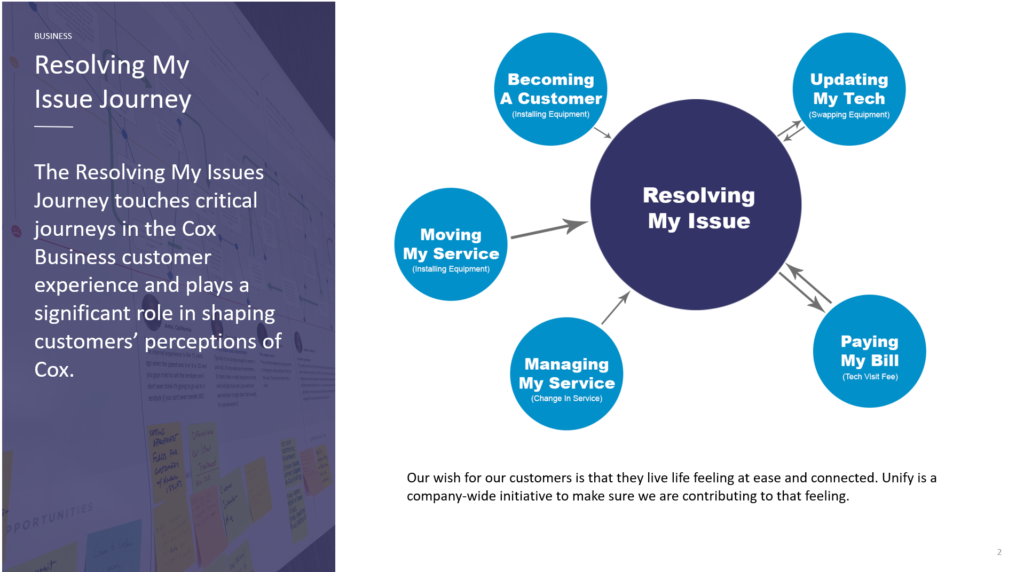
Cox defined six customer journeys:
Become, Manage, Pay, Resolve, Move, Update
But Resolve was different.
Why Resolve is the heartbeat of the brand:
- High Stakes: Outages, billing errors, configuration failures — these aren’t inconveniences. They halt businesses.
- High Frequency: 60%+ of customers encounter at least one Resolve issue yearly.
- High Emotion: Anxiety, frustration, and financial risk all peak here.
Resolve is the moment where the relationship is kept — or lost.
My responsibility:
Rebuild the Resolve Journey end‑to‑end: From the first “Help!” to the final “Fixed.”
Our Approach: Systematic, Holistic, Human‑Centered
For a problem this deep, patching processes wasn’t enough. We applied a journey‑led transformation, driven by design thinking and service design principles.
Step 1 — Deep Diagnosis & Journey Mapping
- Interviewed customers across industries
- Conducted agent listening sessions
- Shadowed support teams and field technicians
- Mapped every step of the existing journey
- Quantified friction, latency, and root causes
Step 2 — Cross‑Functional Alignment
- Workshops with support, billing, engineering, sales, field ops
- Shared definitions of resolution, SLAs, ownership, and hand‑offs
- Created a unified understanding of where and why issues fail
Step 3 — Future‑State Journey & Guiding Principles
We established core design values for the new Resolve experience:
- Clarity — customers always know status, next step, and ETA
- Speed — eliminate wasted time; reduce hand‑offs
- Empathy — acknowledge impact and urgency
- Proactive Prevention — monitor, detect, notify
- One Cox — a single, unified experience across all teams
Step 4 — Pilot, Test, Learn, Refine
We piloted the new journey with real Cox Business customers, iterating based on:
- Resolution time
- Customer anxiety signals
- Agent effort
- Escalation volume
- Customer feedback
The Future-State Resolve Journey
The redesigned Resolve experience focused on three pillars:
Pillar 1 — Diagnose Quickly, Resolve Intelligently
Before the customer even asks:
- Automated service health checks
- Real‑time outage detection
- Configuration anomaly insights
- Immediate visibility for agents
The experience shifted from “tell us what’s wrong” to “we already see it.”
Pillar 2 — One Team, One Journey
Instead of passing customers across departments, we created a unified experience:
- Single case owner
- Unified case history
- Shared tools
- Cross‑team workflow orchestration
- Clear SLAs and timelines
Customers finally felt like someone was accountable.
Pillar 3 — Confidence Through Transparency
Customers received:
- Clear status updates
- Predictable ETAs
- Real‑time technician tracking
- Simple notifications
- Follow‑ups confirming resolution
Trust was rebuilt step by step.
Impact
Although the journey transformation is long‑tail and cross‑functional, early results showed:
- Reduced resolution times
- Fewer hand-offs per case
- Less agent cognitive load
- Higher customer trust and satisfaction
- Fewer escalations
- Greater operational alignment across Cox teams
The experience became:
Simple, predictable, and human.
Final Reflection
The Resolve Journey wasn’t just about fixing outages or correcting bills.
It was about restoring confidence — when customers needed Cox most.
We didn’t just fix processes.
We rebuilt trust at the moment it mattered most.
Resolve is where the brand lives or dies — and now, it lives stronger.